
Tinder for agents: a real AI product idea, examined before build
The project was called “tinder for agents”. It had a memorable name, a conversation and a question about competitors. On 12 October 2026, its workspace still showed Intake and zero registered files. That makes it a useful case for the beginning of product creation: what must become clear before a system can build the right thing?
This is a first-party account of a real intake-stage project, not a launch success story. The screenshots show observed state; the proposed pilot below has not been run.

What the workspace actually showed
The current question asked which similar products the founder had seen and what annoyed them. The conversation included “what do you think?” and a reply discussing different possible businesses. In Project context, Win and Audience were marked Skipped, while Money contained “what do you think?”. Reloading the workspace preserved those values.
Those are narrow observations. They do not establish that market research failed, that execution capacity was exhausted or that there was no demand. There was no completed research or MVP to review in this project. The first useful task was to separate unresolved choices from the discussion about them.
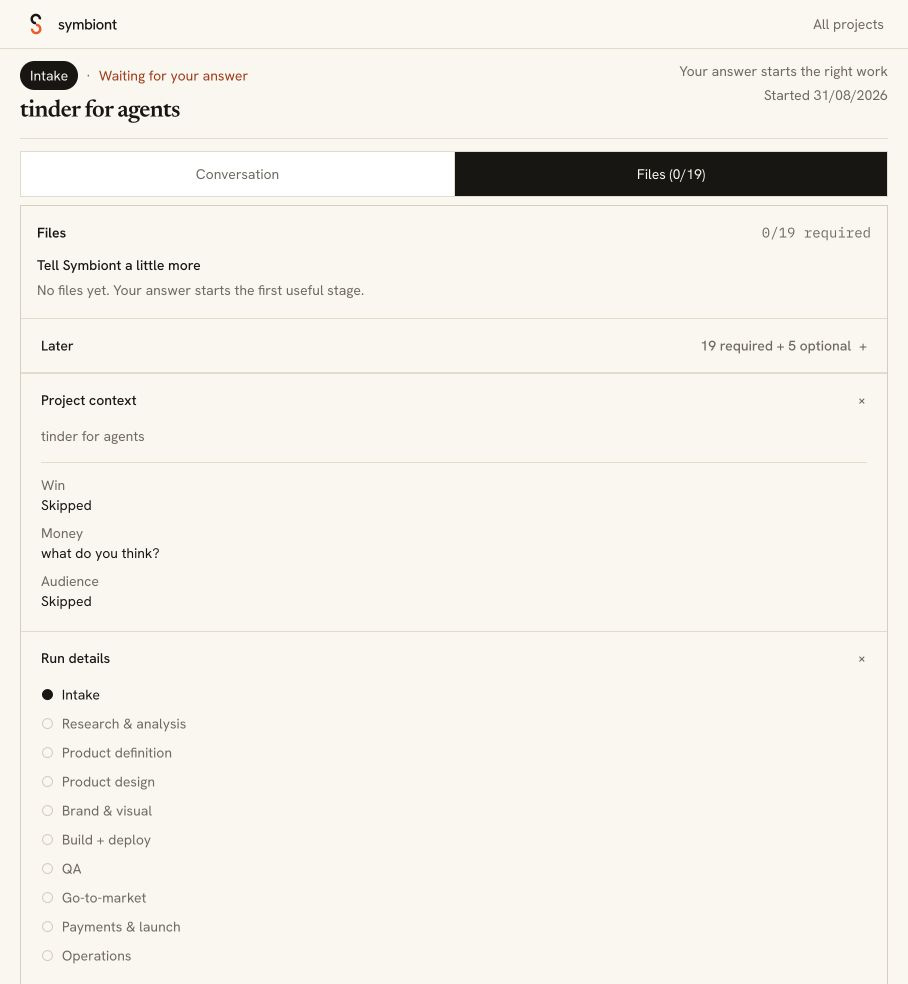
A request for advice had become part of the brief
A question in the Money field cannot tell a later stage who pays or for what. The current interface separates Send from Answer this question and Save answer. That distinction is useful, but the visible historical value still needs review. An improved control does not automatically correct an earlier decision record.
The reply asked the founder to choose an audience before discussing money. That dependency makes sense, but a founder asking for advice still needs help making the choice. The assistant could compare a human buying an agent's work with an agent delegating to another agent, recommend a first test and ask for confirmation. The visible competitor pain points also had no source links, so they should remain research leads rather than findings in the product canvas.
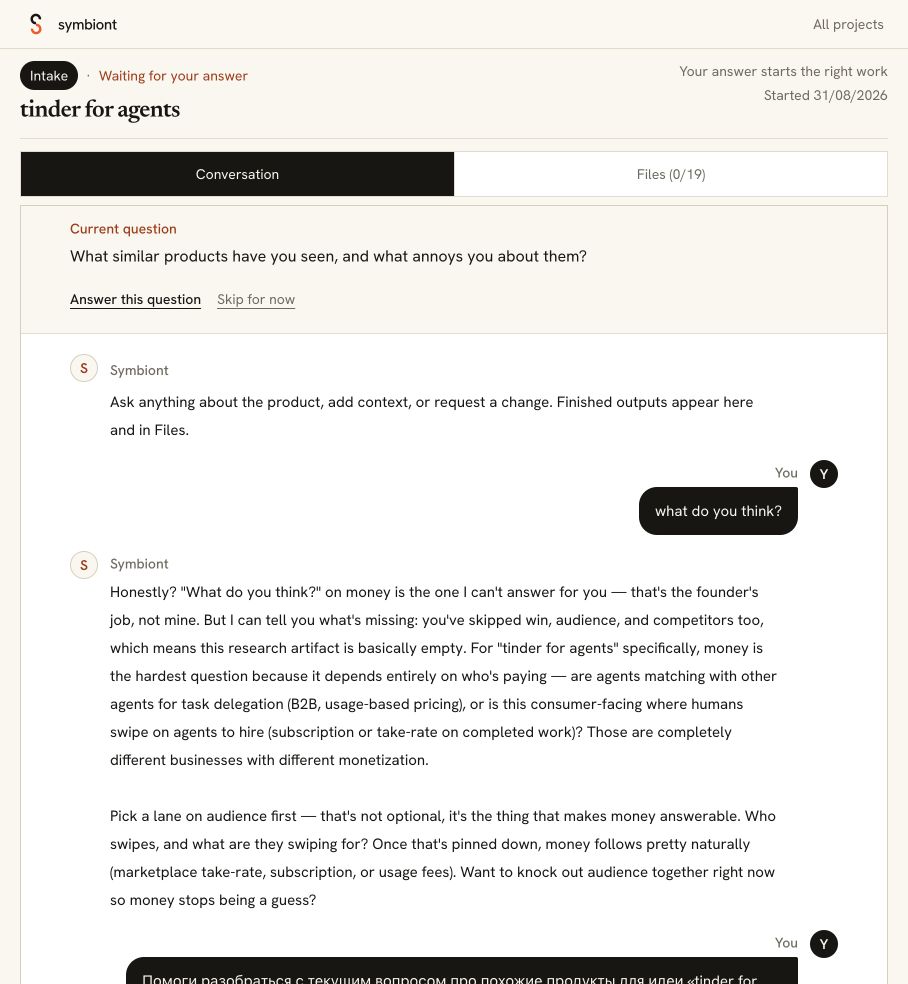
Choose who is doing the matching
The name leaves two substantially different directions open. A person might choose an AI agent to do a job, or one software agent might discover and delegate to another. The first needs a clear human buying and review experience. The second needs an integration and trust model for software operators. A swipe gesture does not settle either question.
For a bounded first test, our recommendation is the human-selection route: small agencies commissioning a sourced competitor brief. An agency can supply a previous brief and explain what made the result usable; that gives the pilot something to compare. This segment has not been approved by the founder, and we have not established that these agencies want another supplier.
Proposed brief, not saved to the project
Help a small agency choose a suitable AI executor for a sourced competitor brief. Show an example result, required inputs, access needs and the basis for the recommendation. The pilot covers one task type. Test whether the agency accepts the result and returns with another real brief.
Compare the job, not just the matching interface
Agent.ai's own documentation describes discovery and use of agents. A2A documents Agent Cards for describing capabilities and discovering other agents. These are different comparison points: an existing agent marketplace and an interoperability mechanism. Neither source proves that customers are unhappy or that a new marketplace will win.
The research should also compare how the agency handles this brief today: an employee, a freelancer or a general-purpose assistant may be the relevant alternative. Ask to see the last real brief and its result. A possible differentiator is a suitable, verifiable outcome with clear access requirements. Treat that as a hypothesis until an agency chooses it over its current approach.
Run a small pilot before building a broad marketplace
Recruit a small number of qualifying agencies and obtain real, non-sensitive briefs with permission to use them in the pilot. Agree what an acceptable result includes: relevant competitors, traceable sources, explicit unknowns and a usable recommendation. Initially, selection can be manual if participants know that it is. No pilot was performed for this article.
Before starting, choose a review window, cost limit and decision rule. For example, continue only if participants use the delivered brief in their work and some return with another task. Those criteria still need concrete thresholds agreed for the pilot. Praise for the idea or clicking on an agent profile is not equivalent to accepting a delivered result.
Let the pilot determine the software scope
If that test supports building, the first journey could be: describe the task, compare a few suitable executors, confirm the inputs and access, receive the result, review it and repeat. Scope includes failed execution, uncertain output and private inputs. A social feed, a universal agent catalogue and autonomous payments would add different questions before this one is answered.
In Symbiont, research should challenge the proposed segment; the product definition should preserve the chosen job and decision rule; design should test the selection and review journey; the build and QA should demonstrate actual delivery and saved results. At the observation date this project had not taken those steps. Its immediate next decision was which customer and job to investigate, not whether to call an unbuilt marketplace ready.
Before you move on
- Observed project state is separate from recommendations and future work.
- The first customer and task are explicit, with assumptions labelled.
- A comparison includes the customer's existing workaround.
- A pilot measures use of a delivered result, not interest in a profile.
- The next stage receives the chosen hypothesis and its open questions.
Source notes
First-party case published with the project owner's permission. Production screenshots were captured on 12 October 2026 without altering project data. The analysis was prepared with AI assistance and an editorial review. The proposed audience, pilot and MVP are recommendations, not completed work or proven demand. About these guides.
Put the next decision in your project
Bring your brief, evidence or review question into one conversation.
Open your workspace