
How to review AI market research before you act on it
An AI research report can be readable, detailed and wrong at the exact point where you need to make a decision. Review the claims that would change your product first. The length of the report is not a useful proxy for the strength of its evidence.
Trace the recommendation back to a source, then ask whether that source supports this customer, market and decision.

Follow a consequential claim to its source
Choose a claim that affects the build: a missing competitor feature, a price, a customer complaint or a distribution opportunity. Open the original source. Check the date, country, plan and customer type. A price for an enterprise plan in another market should not silently become the anchor for a small-studio offer.
The link must support the sentence beside it. A product homepage may establish that a competitor exists; it does not necessarily prove why customers leave it. If the source cannot be inspected, mark the claim as unverified and decide whether it is important enough to research again. Do not replace the missing evidence with a more confident paragraph.
A claim worth challenging
“Studios need a cheaper approval tool” bundles two claims: price is the obstacle, and a cheaper product solves it. A competitor pricing page can support the first comparison of prices. It cannot establish the customer's reason for switching. That needs customer evidence.
Include the workaround that already wins
For a handoff product, compare email, shared documents and doing nothing alongside specialist software. These alternatives already fit the customer's habits. Your product may save reconciliation time while introducing another login, another subscription and another place to lose a file.
Ask for a comparison of the same job under the same constraints. Separate published features from features someone actually tested. If the report says an alternative lacks something, check whether it is absent, available on another plan, or simply not found during the research. Those lead to different product decisions.
Separate observations, inferences and open questions
Use three simple labels in your review. An observation is something a source or test shows. An inference explains what it might mean. An open question is what you still need to learn. The report should not turn “three people described this problem” into “most studios need this product”.
Ask for the strongest case against the recommendation. Perhaps the workflow is too infrequent, the buyer is not the user, or customers cannot share the required files. These are useful research results. A recommendation that survives only because inconvenient alternatives were omitted is not ready to guide the build.
Copy into the project conversation
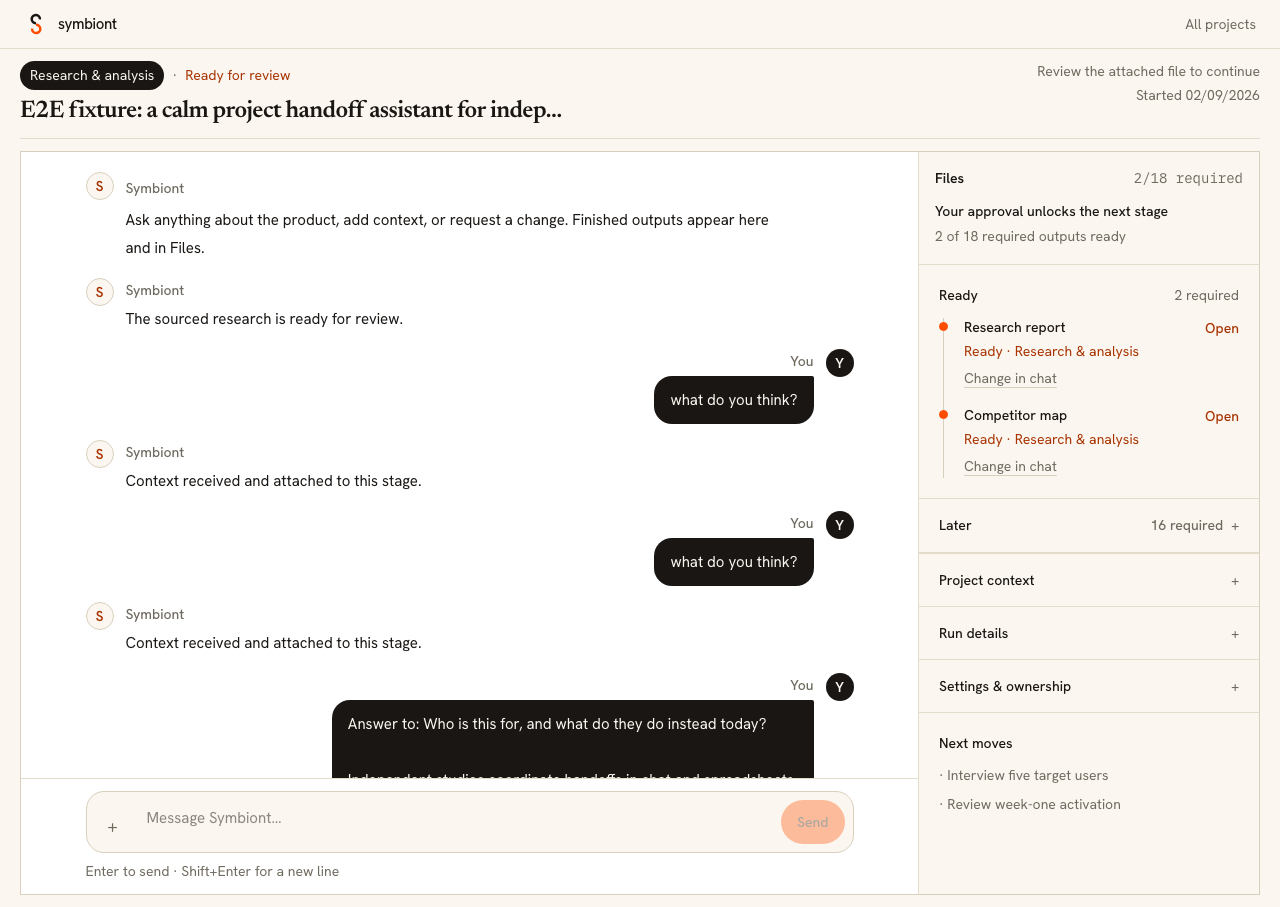
Review the research against my original brief. For each claim that changes the MVP, show the supporting source, its date and scope. Separate observed facts from inference. Include today's workaround, the strongest reason not to build, and the smallest next test. Flag anything you could not verify.
Carry decisions into the next stage
Before approving research, write a short decision note: the target user, the selected problem, what is supported, what remains uncertain and the next test. For the studio tool, that might mean keeping the small-studio audience but dropping a pricing assumption until someone has discussed a real purchase. The next scope should inherit that decision, not merely link to the report.
When the next artifact arrives, compare it with that note. Did the audience change? Did a cautious hypothesis become a promised feature? Did the prototype solve the original problem? In Symbiont, keep that review in the same project conversation and name the output you want revised. Approve the work after the discrepancy is resolved.
Before you move on
- Important links open and support the adjacent claims.
- Dates, geography, pricing plans and customer segments are explicit.
- Competitors include the current workaround.
- Facts, interpretations and unknowns are distinguishable.
- The recommendation includes counterevidence and a next test.
- The next artifact preserves the decisions I approved.
Prepared with AI assistance from Symbiont’s product workflow. Examples are illustrative; interface captures use demonstration data. About these guides.
Put the next decision in your project
Bring your brief, evidence or review question into one conversation.
Open your workspace